
The next large, repeatable productivity gain for businesses won’t come from hiring one more specialist or buying a point product, it will come from deploying agentic AI: autonomous systems that plan, act, and complete multistep workflows inside business processes.
When designed around clear KPIs, these “digital employees” can cut costs, speed decisions, and scale expertise across teams, not as a novelty, but as measurable, repeatable contributors to the P&L.
How agentic AI earns its keep
Agentic AI (AI that can plan, act, and carry out tasks across steps) moves beyond single-response chatbots to execute structured work: triaging tickets, assembling reports, provisioning cloud resources, or autonomously adjusting campaigns.
That translation from suggestion to execution is what creates real operational leverage, less time waiting for human follow-up, fewer manual hand-offs, and fewer errors from repetitive tasks.
Here’s the business math you can expect right now: a majority of firms report practical GenAI use, and organizations that have modernized processes around AI see outsized financial returns.
In a recent McKinsey survey 65% of respondents said their organizations were regularly using generative AI, signaling broad operational adoption.
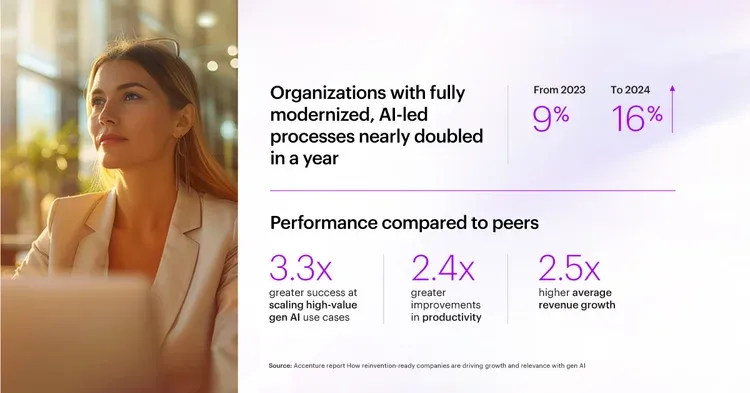
Companies that reorganize around AI-led processes report up to 2.5× higher revenue growth and 2.4× greater productivity versus peers who haven’t, evidence that the payoff is not just technical but commercial.
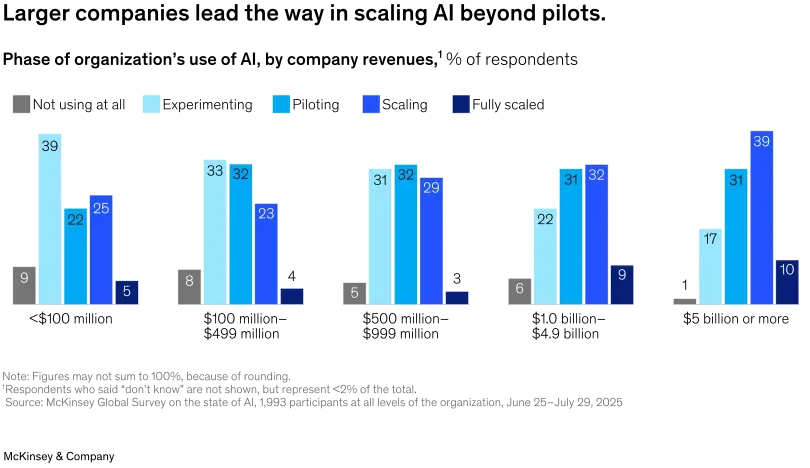
Early large-scale surveys also show that a meaningful minority are moving from pilots to scaling agentic systems: about 23% reported scaling agentic AI within at least one function, with another large cohort experimenting, which means the approach is already leaving the lab.
And in customer-facing functions, conversational automation alone has shown material cost impact, studies and vendor analyses put customer-service cost reductions in the ~30% range when routine contacts are handled by AI agents and escalation flows are optimized.
Real gains require three engineering moves (not hype)
Treat agentic AI like a new category of staff: hire for outcomes, instrument performance, and limit autonomy until confidence is proven.
-
Outcome-first design: Start with a high-frequency, high-cost workflow (e.g., claims triage, order exceptions, vendor onboarding). Define the acceptance criteria a human would use, then let the agent run within tight guardrails.
-
Observability and KPIs: Instrument every interaction — time saved, resolution accuracy, error rates, cost per case and tie them to a business metric (revenue, cost-to-serve, SLA attainment). Use those metrics to justify expanding autonomy.
-
Phased autonomy with human-in-the-loop: Begin with suggestion + human approval, progress to supervised autonomy, then to unsupervised execution for low-risk tasks. This reduces false positives and prevents the common failure mode of “agent washing” (relabeling simple automation as agentic capability).
Risk, governance, and a minimal viable plan
Agentic AI projects deliver value when built with rigorous guardrails. That means clear data lineage, an escalation map for uncertainty, model-version control, and a small cross-functional steering group (ops, legal, security).
Expect to fail some experiments, analyst firms forecast a non-trivial cancellation rate for immature projects but treat failures as rapid learning: short cycles, instrumented rollback, and reusable patterns.
A minimal viable plan (30–90 days): pick one process with measurable volume and cost; map inputs/outputs; build a narrow agent prototype; run it in supervised mode for 2–4 weeks while collecting KPIs; then scale if accuracy, cost, and compliance targets are met.
Because companies that commit to AI-led processes report materially higher growth and productivity, this disciplined path converts experiments into repeatable business outcomes.
Agentic AI is not an optional experiment, it’s a new operating lever. When scoped to concrete outcomes, instrumented with rigorous KPIs, and governed with clear safety nets, these digital employees pay back in lower operating cost, faster decisions, and greater capacity to scale expertise.
The real question for leaders now is whether to treat agentic AI as a one-off experiment or as a repeatable capability that shifts how work gets done.