Nvidia’s GPUDirect technology has shifted the focus towards optimizing storage array bandwidth. The company's SuperPOD certification for third-party hardware highlights key factors such as bandwidth, latency, scalability, and the ability to handle large datasets.
Recent updates include WEKA’s SuperPOD certification as of September 4, 2024, and Dell’s certification as of September 5, 2024.
GPUDirect Storage (GDS) was designed to bypass the traditional host OS and CPU-memory pathways of a storage server or array controller by utilizing direct IO to NVMe storage drives.
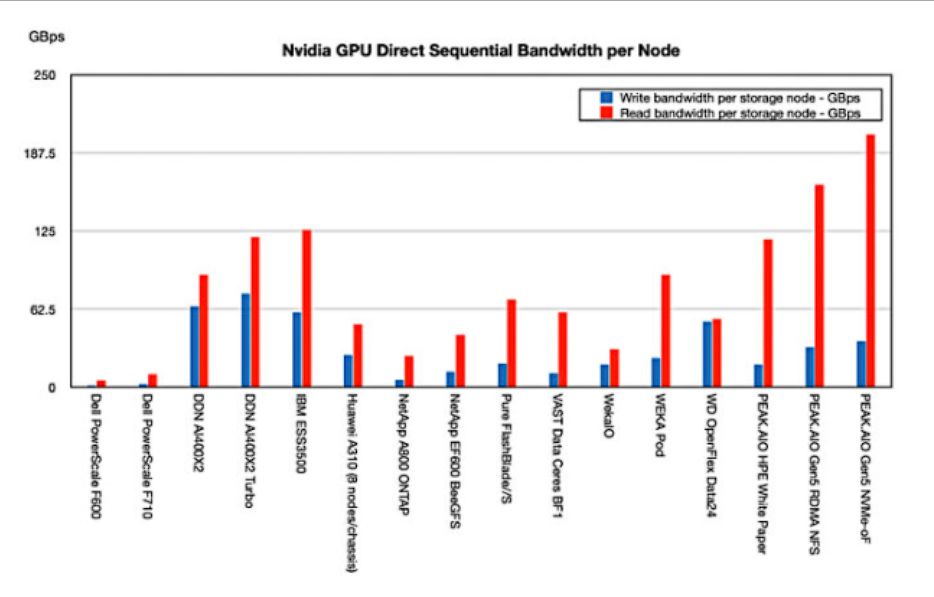
This innovation significantly accelerates read and write operations. Vendors have showcased their GDS performance, offering a clear benchmark for comparison.
Nvidia’s SuperPOD Certification: Redefining AI Storage Standards
Over the past few years, we've gathered data from ten suppliers, as shown in the chart above. The AI market is evolving, with a clear distinction between training and inference workloads, the introduction of Retrieval-Augmented Generation (RAG) and vector search, and the concept of an AI data pipeline.
Modern AI storage must support all stages of this pipeline and effectively cater to both inference and training data needs.
Nvidia’s DGX SuperPOD, its largest GPU server, has certified storage suppliers to ensure they offer more than just high-speed data transfer to GPUs. While bandwidth remains important, it is no longer the sole focus.
The key is to provide a comprehensive performance solution that keeps the SuperPOD operating efficiently while meeting Nvidia’s latency, sustained performance, scalability, large dataset management, and compatibility requirements.
Performance alone is crucial, but scalability is equally vital. Hari Kannan, Senior Director at Pure Storage, emphasized, “Nvidia SuperPOD certification is centered around performance. SuperPOD guarantees a high level of performance at a massive scale.
We’ve shared our performance benchmarks with Nvidia, who conducted their own testing to ensure we meet their SuperPOD standards.” These benchmarks are proprietary and not publicly available.
Currently, six storage suppliers are certified for SuperPOD: DDN with its A³I A1400X2T Lustre array, Dell with PowerScale using Ethernet storage, IBM with Storage Scale System 6000, NetApp with EF600 running BeeGFS, VAST Data with its Data Platform, and WEKA.
Of these, five offer parallel file system access, while Dell’s PowerScale provides clustered, scale-out OneFS file system.
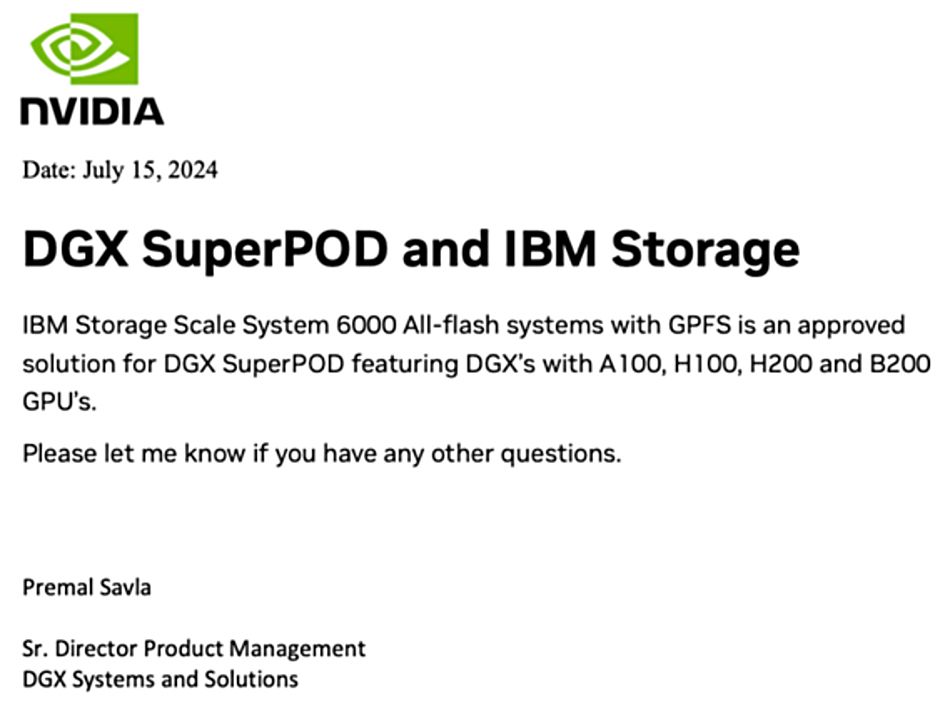
Dell Enhances PowerScale; SuperPOD Certification Updates
Dell is enhancing its PowerScale OneFS operating system with parallel file system support through Project Lightning. This upgrade could further align PowerScale with the performance and scalability requirements for SuperPOD certification.
Pure Storage and Hitachi Vantara are among the suppliers planning to support SuperPOD. Hitachi Vantara, which already holds BasePOD certification for its VSP One storage, is expected to pursue SuperPOD certification as well.
We are awaiting confirmation on whether NetApp’s ONTAP AFF arrays will achieve SuperPOD certification and will update this information once available.
MinIO has stated that its open-source DataPOD object storage can scale to support any number of GPU servers, but it is not seeking SuperPOD certification. SuperPOD certification is focused on file system storage, despite the potential presence of object storage.
The SuperPOD certification process is more about compatibility than raw performance.
Nvidia aims to have a variety of storage suppliers certified for SuperPOD access, rather than creating a public benchmark for performance comparison. Consequently, detailed performance metrics for SuperPOD-certified storage suppliers are unlikely to be released.