
Large language models (LLMs) have become the poster child of progress.
Their ability to understand and generate human-like language has revolutionized industries—from marketing and customer service to code generation and creative writing.
But while LLMs like GPT-4 have dazzled with their linguistic prowess, they’re not the future. They’re only the beginning.
As AI systems face growing demands to operate in dynamic environments, respond to real-world events, and autonomously execute complex tasks, a fundamental shift is underway.
We are entering the age of agentic AI—a class of AI that doesn’t just talk, but thinks, acts, and adapts. For business leaders, this transition represents both a competitive opportunity and a strategic imperative.
From Passive Predictions to Proactive Intelligence
LLMs are trained on massive datasets and designed to predict the next most likely word in a sequence.
That might sound simplistic, but it underlies their remarkable fluency and flexibility.
However, when it comes to action—scheduling meetings, navigating systems, executing decisions—they hit a hard limit.
Take this scenario:
“Reschedule all my meetings tomorrow to Friday, if Friday is clear, and send out updated invites.”
A traditional LLM could write you a detailed, grammatically perfect guide on how you could reschedule those meetings. But it won’t check your calendar. It won’t interact with your email.
It won’t send a single invite.
That’s where agentic AI enters the picture.
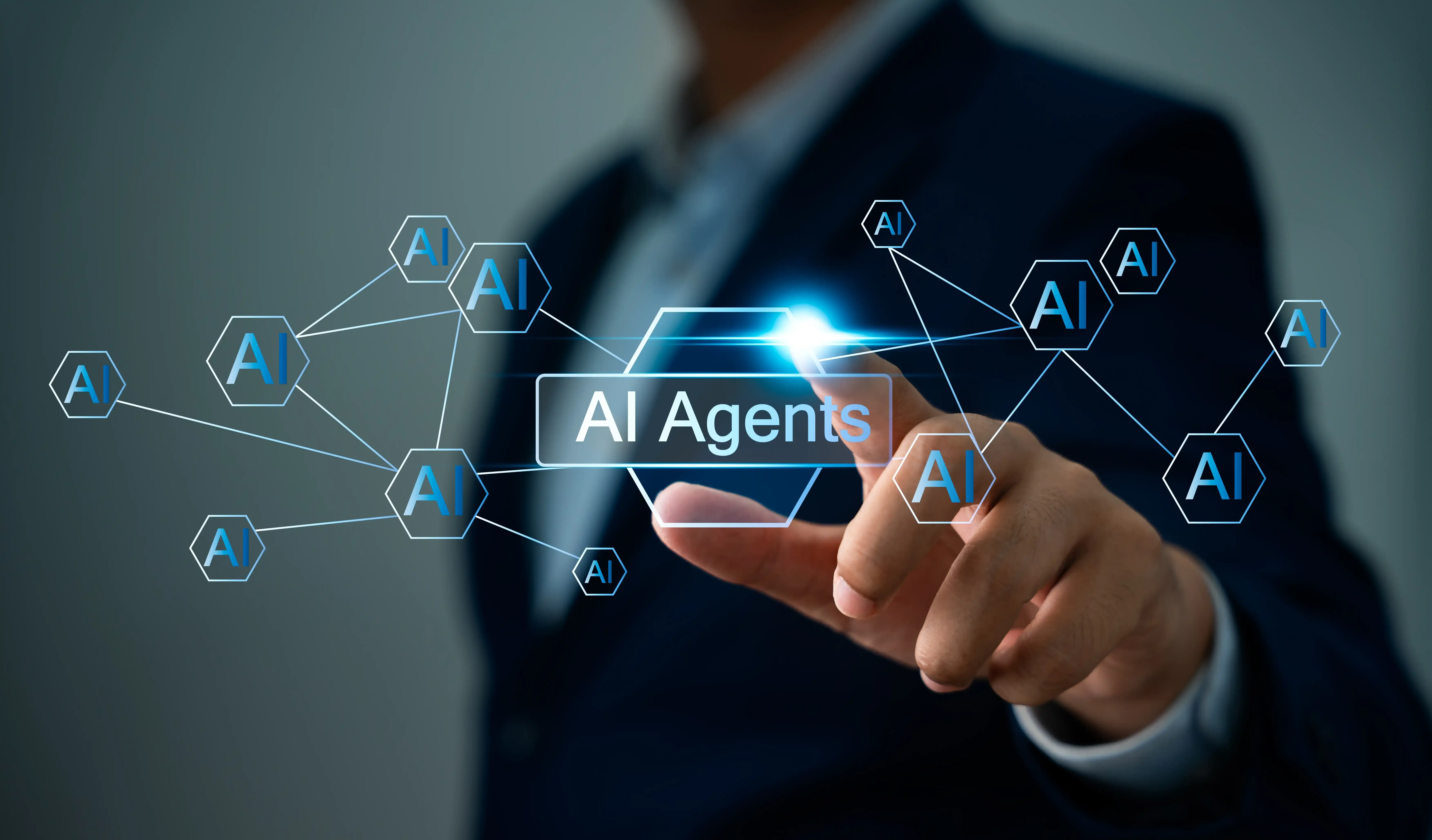
Agentic AI combines the linguistic intelligence of LLMs with the ability to interact with real-world data, tools, and systems.
These agents can perceive dynamic conditions (like a temperature sensor or sales data), reason about them, and act autonomously—rescheduling meetings, sending emails, updating CRM records, or adjusting smart devices in real time.
For executives looking to automate operations or streamline decision-making across departments, this is game-changing.
Limits of Standalone LLMs: Why Text Isn’t Enough
Let’s break down the core limitations of relying solely on LLMs:
-
No real-world interaction: LLMs can’t connect to your systems unless embedded in larger frameworks. They don’t “act”—they suggest.
-
Stale knowledge: LLMs are trained on historical data and don’t inherently know about anything that happened after their cutoff date.
-
No memory or context management: They don’t recall previous actions unless explicitly told, making them unsuitable for long-term workflows.
-
Scalability issues: As you build more features around an LLM, the system becomes harder to manage, update, and maintain.
-
Lack of agency: They can't verify outcomes or correct mistakes on their own. They don’t loop, they don’t learn from feedback, and they don’t persist tasks.
Consider another example:
You prompt an LLM:
“Monitor the living-room temperature. If it exceeds 24°C for 5 minutes, turn on the fan and dim the lights to 40%. If it drops below 22°C, turn the fan off and restore lighting.”
A standalone LLM might write a great essay on how such a system could work—but it won’t actually monitor, control, or adapt.
It doesn’t know what 24°C feels like, let alone how to interface with a smart home ecosystem.
Agentic AI, on the other hand, can monitor, can decide, and can act.
Agentic AI: Business Operating System of the Future
This is more than a technical evolution—it’s a strategic leap. Agentic AI enables businesses to:
-
Automate complex workflows without scripting every step manually
-
Create proactive digital employees that manage systems, data, and communication on their own
-
Reduce overhead and cognitive load on human teams by handling repetitive, multi-step tasks
-
Accelerate response times across customer service, logistics, IT support, and operations
-
Deliver hyper-personalized experiences based on real-time inputs and ongoing memory
At its core, agentic AI redefines how work gets done.
Imagine an agentic AI that manages your HR system. An employee says,
“I want to apply for parental leave starting next month.”
The agent doesn’t just generate a policy summary—it checks eligibility, fills out forms, confirms dates, and routes the request for approval.
Now imagine that same logic across supply chains, finance, marketing automation, customer service, and product development.
Generative AI gave us a voice. Agentic AI gives that voice power.
For executives thinking about the future of their operations, digital transformation, and competitive edge, the question isn’t whether LLMs are useful.
It’s whether they’re enough. If your AI stops at generating text, you’re leaving transformational value on the table.